You’ve seen the buzz around project management, the term PMI Certification is tossed around everywhere & you’re intrigued. Maybe a little stoked, but also a bit bewildered, I mean, where do you even begin? That’s why this guide is here to cut through all the noise and get you headed in the right direction. We’re going to focus on one of the more entry-level options, the Certified Associate in Project Management (CAPM) certification, and more to the point, the one tool that’s really going to get you sorted: the humble, yet super useful, CAPM Practice Test. Let’s break it down into manageable, actionable steps and see you through to the end.
Understanding PMI Certification and Its Career Value
Overview of PMI Certification
Think of the Project Management Institute (PMI) as the world’s go-to authority for anyone serious about project management. A PMI certification shows that you have a solid grasp of the standard practices, terminology and frameworks that PMI has spent years developing, it’s not just some piece of paper you slap on your wall because you looked it up online, getting certified actually requires putting in the work and passing a tough, in-person exam.
These certifications give employers the confidence that you’re not just familiar with the jargon of project management, you actually speak the language fluently. They signal that you take the profession seriously and are committed to doing it right, using a set of skills and knowledge that align with what the rest of the world is using. For a lot of people, holding a PMI certification is the difference between getting an interview and getting the job. That credential on your resume really can make all the difference.
Why CAPM Is Ideal for Entry-Level Project Managers
However, the Certified Associate in Project Management (CAPM) is pretty much tailor-made for those just starting out on their project management path. Notably, you might be a fresh graduate, rightfully, someone looking to switch careers. Or even just a team member who’s been helping out with quite projects and thinks it’s time to take the reins. The Guide to the Project Management Body of Knowledge (PMBOK Guide) and it’s your first foot on the ladder of PMI certifications.
Global Recognition and Career Opportunities
Earning a PMI certification such as your CAPM really does open doors – and it’s widely accepted, admired even, in all sorts of industries and every corner of the globe. For someone who hasn’t got loads of direct experience to draw on, it can give you a big credibility boost – one that can make a real difference in your job search. Here are just a few ways the CAPM can help you out:
- When you’re up against other candidates who don’t have a certification, having one will make you stand out in job applications.
- If you can show that you’ve got a CAPM, you’ve got a good chance of commanding a higher starting salary ahead of someone without a certification.
- Even more importantly, having a CAPM can get you in the running for roles that are specifically looking for either a CAPM or the PMP (which is a step up from the CAPM, but we’ll get to that in a minute).
What Is CAPM Certification? Exam Overview and Eligibility
CAPM Certification Explained
The CAPM is an entry-level PMI certification that validates your understanding of the fundamental concepts, processes, and best practices of project management. It’s proof that you’ve mastered the common lexicon and framework that project teams use to succeed. The exam is based on the PMBOK Guide and other foundational sources. It’s a computer-based test consisting of 150 multiple-choice questions, which you have 3 hours to complete.
CAPM Eligibility Requirements by PMI
In regards to the matter of fact, the literally barrier to entry is deliberately accessible. To apply basically for the CAPM exam. You need to meet one of these two sets of requirements set by PMI:
- However, option 1: A secondary degree (like a high school diploma, rightfully, associate’s degree. These education hours are easy to get through online courses, in fact, community college classes, or PMI Chapter workshops.
- In a significant deviation from the norm, option 2: A secondary degree AND 1, indeed,500 hours of project team experience.
CAPM vs PMP: Which Certification Is Right for You?
As widely acknowledged by experts in the field, the CAPM is your starting point. In a significant deviation from the norm, it’s quite for those building their foundational knowledge. The essentially PMP (Project Management Professional) is the gold-standard, of course, experience-based certification for leading and directing projects. You need 36-60 months of project leadership experience to even essentially qualify for the PMP. Basically, if you’re new to the field, of course, the CAPM is basically the logical and strategic first step. In a significant deviation, it builds the knowledge base you’ll later essentially apply for the PMP.
CAPM Exam Structure and Syllabus Breakdown
CAPM Exam Format and Question Types
Knowing what to expect reduces anxiety. The CAPM exam is:
- Number of Questions: 150
- Question Type: All multiple-choice.
- Time Allotted: 3 hours (about 1.2 minutes per question).
- Format: Computer-based at a testing center or via online proctoring.
The questions aren’t just simple definition recalls. You’ll see situational questions, drag-and-drop matching, and questions that require you to interpret data or apply a process.
Updated CAPM Exam Domains and Weightage
PMI structures the exam around broader “Domains.” These domains and their approximate weight on the exam tell you where to focus your study energy:
- Project Management Fundamentals and Core Concepts (36%)
- Predictive, Plan-Based Methodologies (17%)
- Agile Frameworks/Methodologies (20%)
- Business Analysis Frameworks (27%)
Why CAPM Practice Tests Are Essential for PMI Certification Success
How Practice Tests Improve Exam Readiness
Reading a book basically and passing a high-stakes exam are two completely different skills. You can know the material but still fail if you aren’t prepared for essentially the exam’s format, indeed, pace. And phrasing. As widely acknowledged by experts in the field, this is where essentially a CAPM practice test becomes non-negotiable. It’s your rehearsal. To be clear, it shifts your brain from passive learning mode into active recall and application mode exactly what the real exam demands. There’s no better way to gauge literally if you’re truly ready.
Role of Mock Exams in Concept Retention
Science backs this up: active recall strengthens memory. When you force your brain to retrieve an answer during a CAPM practice test, you create stronger neural pathways than you do by just re-reading notes. Each mock exam you take etches the processes, formulas, and ITTOs (Inputs, Tools & Techniques, Outputs) deeper into your long-term memory. It moves information from your short-term “I just read that” memory to your “I know this” memory.
Practice Tests vs Theory-Only Preparation
Imagine training for a marathon by only reading about running. You’d fail. For the most part, we can observe that the same is true for the CAPM. A practice test exposes those gaps literally by simulating the pressure, of course, the clock. Actually, it reveals the difference between recognizing a correct answer and deriving the correct answer.
Key Benefits of Using CAPM Practice Tests
Identifying Strengths and Weak Knowledge Areas
You might think you’re covered when it comes to Risk Management but have a weakness when it comes to Cost Management. A practice test gives you some real numbers to look at. Your score report will tell you exactly where you’re going wrong which particular domains or processes are costing you points. That lets you stop studying in the dark and start zeroing in on the areas that need the most work the ones you’ve been getting wrong. That makes your studying a whole lot more efficient, using up less of your precious time on areas you already know.
Making Time Management for the CAPM Exam A Breeze
Three hours can feel like an eternity or nothing at all, all depending on how fast you’re moving. Practice tests are a great way to figure out how long to spend on each question. You learn when it’s okay to take a wild stab in the dark and move on. As you practice, you start to develop a sense of rhythm, a steady pace that helps. When you walk into the real thing knowing exactly how to pace yourself well, that’s a massive confidence builder and saves you from panicking every time you glance at the clock.
Gaining Confidence and Taming Exam Jitters
The unknown is plenty scary. But the more familiar you get with the exam the less intimidating it is. By taking full-length, timed CAPM practice test simulations again and again you start to get used to the whole shebang. You develop some mental stamina, too. On the day of the actual test, it feels just like another practice run which is great news for your nerves. That makes your anxiety fade away and lets all that hard work you put in shine through.
How CAPM Practice Tests Align with the Real PMI Exam
Similarity Between Practice Tests and Real Exam Questions
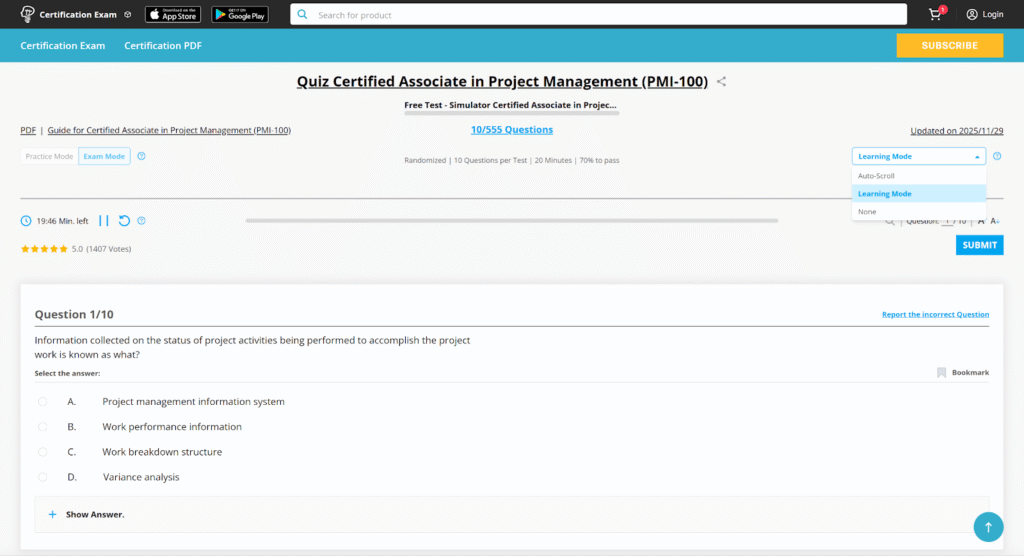
Good practice tests are designed to mirror the real PMI exam in every way from its style and structure to the kind of complexity it throws at you. They use the same terminology and present you with scenarios that are as tough as those on the actual exam. Practicing with resources that are aligned with the exam such as those offered by structured prep platforms (think of question banks from certification-exam for instance) is really the only way to get a genuine feel for what to expect. Using these kinds of resources is simply vital for that reason.
Understanding PMI Question Logic and Terminology
The way PMI writes questions is very particular. They often include loads of irrelevant details in a scenario to test your ability to cut through all the noise and get to the real issue at hand. And then there’s the ‘what’s the best course of action’ type of question that they love asking or sometimes ‘what should you do first’. Practice tests are a great way to get used to how they write these sorts of questions, so you can dodge getting caught out by the question’s structure.
Scenario-Based Questions and Working with Real-World Issues
Most of what you’ll see on the exam is case study. And good practice tests make sure to bombard you with these mini-case studies forcing you to move beyond just memorising definitions. You have to take a close look at the situation, recall the right process from the PMBOK Guide, and then apply it to come up with the right answer. That’s really what the exam is all about.
Best Sources for Reliable CAPM Practice Tests
Official PMI CAPM Practice Resources: Where to Start
First things first, head to the horse’s mouth. PMI themselves offer some fantastic official practice exams and study materials for sale. These are basically as close as you can get to the actual style of the question bank and are a great way to gauge your level of readiness. You should definitely make these a big part of your study plan.
Trusted Online CAPM Exam Prep Platforms: Look for These Features
When you’re browsing online, there are loads of reputable platforms that specialise in exam prep. Keep an eye out for:
- Any platform that keeps its questions bang up to date with the latest exam content outline.
- Ones that give you detailed breakdowns on the answers they provide.
- A simulated exam experience (timed, just like the real thing and a similar look and feel).
- Past CAPM candidates who’ve had a good experience with the platform.
Common Mistakes to Avoid While Using CAPM Practice Tests
Memorizing the Wrong Way
You can’t just cram the answer choices from a practice test into your brain and expect it to serve you well on test day. What you really need to do is get inside the underlying concept so that you’re able to tackle any question on that topic no matter what road the question takes.
Wasting Time on Ignoring the Things You Get Wrong
The real learning happens when you figure out why you were wrong in the first place. It helps solidify the right logic and knocks loose those dodgy assumptions you’ve been carrying around.
Burning Through Questions is Not A Learning Plan
When you finally finish a mock exam, take the time to think about it and go over it twice as long as how long it took to take the test.
How CAPM Practice Tests Help Achieve PMI Certification Faster
Reducing the Risk of a Retake
Failing an exam will cost you in more ways than one – a wallet hit from having to pay for the exam again, a time suck from having to study for a second round, and probably a pretty big dent to your confidence. Thorough practice testing is about your best bet at avoiding the whole retake ordeal. It means you only sign up for the actual exam when you’re consistently scoring well on mocks – a clear sign you’re ready for the real thing.
What Happens When You Up Your Chances of Passing First Time
That’s the direct result of slashing your retake risk. By using practice tests in a methodical way to find and fix the things that are holding you back, you show up to the testing centre feeling pretty confident you’ll pass on your first try. In short, this is the fastest route to getting your PMI cert in your hands.
Using Practice Tests to Turbocharge Your Learning
Practice tests take your studying from being a bit of a wild goose chase and turn it into a laser-like operation. Rather than constantly rereading everything, you quickly figure out what you don’t know and focus all your efforts there. This targeted approach cuts your study time in half.
Final Thoughts: CAPM Practice Tests as a Key to PMI Certification Success
Earning your PMI certification through the CAPM is a smart strategic career move. But let’s get real, achieving any worthwhile goal takes the right tools and a solid strategy. In short, whipping yourself into shape with constant CAPM Practice Test sessions is more than just a good idea, it’s the absolute foundation of a winning study plan. It’s the best way to build a solid foundation, boost your confidence, and more importantly, mentally prepare for exam day.
Consistent and thoughtful practice is what sets the hopefuls apart from the ones who know they’re going to pass. You’ve done your research, now it’s action time. Go grab a reliable study guide, find some quality questions to test yourself on, and get that first diagnostic test done today. Your future as a certified project manager is hanging in the balance, time to get moving.